
Retatrutide phase 3 results explained — 7 critical facts.
The retatrutide phase 3 results reported in 2025 and 2026 represent the most significant clinical milestone in obesity medicine in a generation. TRIUMPH-4 in December 2025 delivered 28.7% mean weight loss at 68 weeks. Then TRIUMPH-1 in May 2026 — the pivotal obesity trial — showed 25.0% at 80 weeks, with the 104-week extension reaching 30.3% and no plateau in sight. These are not incremental improvements over existing drugs: they are a different category of result.
This guide breaks down every published retatrutide phase 3 result to date, explains what each number actually means in real-world terms, covers the new safety signal that emerged, compares the results to tirzepatide and semaglutide, and explains what the remaining readouts still need to show. For the regulatory implications, read our guide on when will retatrutide be approved UK. Full trial data is published at ClinicalTrials.gov.
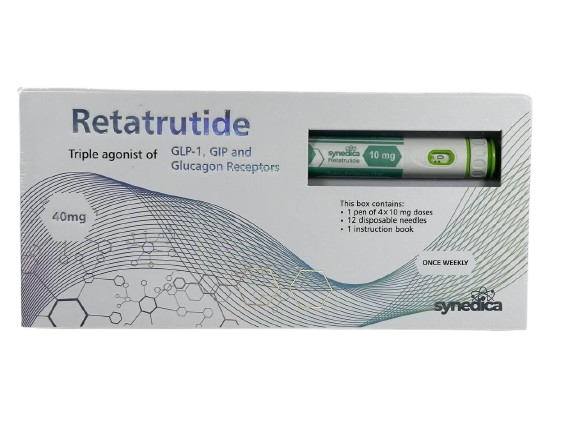
Synedica Retatrutide — £190 for 40mg, COA included with every order.
Explore Synedica →Retatrutide Phase 3 Results — fact 1: TRIUMPH-4 (December 2025)
The first retatrutide phase 3 results to reach the public came from TRIUMPH-4, reported in December 2025 by Eli Lilly. This trial enrolled adults with obesity and knee osteoarthritis — a population chosen because it demonstrates meaningful results in both metabolic and musculoskeletal domains simultaneously.
At 68 weeks, participants on retatrutide 12mg achieved a mean body weight reduction of 28.7% — equivalent to approximately 71.2 lbs (32.3 kg) for a person starting at 248 lbs (112 kg). Beyond weight loss, the trial produced remarkable secondary findings: WOMAC pain scores reduced by up to 75.8% on average, and more than 1 in 8 retatrutide-treated participants were completely free from knee pain at trial end. The combination of metabolic and analgesic outcomes in a single weekly injection generated significant clinical interest — the retatrutide phase 3 results from TRIUMPH-4 effectively established that the compound’s effects extend meaningfully beyond weight loss alone.
Retatrutide Phase 3 Results — fact 2: TRIUMPH-1 (May 2026)
TRIUMPH-1, reported on May 21, 2026, is the pivotal retatrutide phase 3 result that will anchor Eli Lilly’s regulatory submission. This is the largest trial in the TRIUMPH programme, enrolling 2,339 participants with obesity or overweight and at least one weight-related medical condition but without type 2 diabetes — the same population design as SURMOUNT-1 for tirzepatide and STEP-1 for semaglutide.
| Dose | Weight loss at 80 weeks | vs placebo (3.9%) |
|---|---|---|
| Retatrutide 4mg | 17.6% | +13.7 percentage points |
| Retatrutide 9mg | 23.7% | +19.8 percentage points |
| Retatrutide 12mg | 25.0% | +21.1 percentage points |
All three doses met the trial’s primary and key secondary endpoints. The 12mg dose produced mean waist circumference reductions of 9.5 inches — a cardiometabolic risk marker that carries independent clinical significance beyond bodyweight. Additional secondary findings included approximately 20% reduction in LDL cholesterol and a 72% reversal rate of prediabetes to normoglycaemia in the affected subpopulation. These retatrutide phase 3 results collectively represent a substantially stronger metabolic profile than any previously approved obesity medication.
Retatrutide Phase 3 Results — fact 3: the 104-week extension
The most striking element of the TRIUMPH-1 retatrutide phase 3 results is not the 80-week primary endpoint — it is the 104-week extension data. At two years, participants on retatrutide 12mg achieved a mean body weight reduction of 30.3%, equivalent to approximately 85 lbs (38.5 kg). This is the largest weight loss ever recorded in a Phase 3 randomised controlled trial of a pharmaceutical compound.
Critically, the 104-week data showed no weight-loss plateau — the curve was still descending at the point of measurement. This is a genuinely important mechanistic signal: most GLP-1 class medications show plateau by 52-68 weeks. The absence of plateau in the retatrutide phase 3 results at 104 weeks suggests the compound’s triple agonist mechanism may sustain weight loss longer than single or dual agonists. Whether this eventually plateaus at even longer follow-up remains to be seen in the TRIUMPH-OUTCOMES data.
At 12mg, 45.3% of participants achieved 30% or more body weight loss at 80 weeks — a threshold historically associated with bariatric surgery outcomes. This means nearly half of all trial participants on the highest dose achieved weight loss comparable to surgical intervention through a weekly injection alone, a retatrutide phase 3 result that has materially shifted clinical expectations for what pharmacological obesity treatment can achieve.
Retatrutide Phase 3 Results — fact 4: the diabetes trial
The retatrutide phase 3 results from the type 2 diabetes population came from TRANSCEND-T2D-1, reported in March 2026. This trial enrolled participants with type 2 diabetes and showed retatrutide 12mg producing 16.8% mean weight loss at 40 weeks — a strong result, though lower than the TRIUMPH-1 non-diabetic population figure.
This differential is entirely consistent with the established pharmacological pattern across the GLP-1 class: diabetic populations typically achieve lower relative weight loss than non-diabetic populations because the diabetic metabolic environment responds differently to incretin signalling. Tirzepatide showed 20.9% in non-diabetic SURMOUNT-1 versus 15.7% in diabetic SURMOUNT-2; semaglutide showed 14.9% versus 9.6%. The retatrutide phase 3 results follow the same pattern while maintaining a clear performance advantage over both comparators in both populations.
Retatrutide Phase 3 Results — fact 5: safety and the new dysesthesia signal
The retatrutide phase 3 results safety profile is broadly consistent with the GLP-1 class, with the addition of one notable new signal. The most common adverse events in TRIUMPH-1 were gastrointestinal and dose-related, peaking during dose escalation then decreasing:
- Nausea: 28.6% / 38.4% / 42.4% at 4mg / 9mg / 12mg vs 14.8% on placebo
- Diarrhoea: 25.2% / 34.1% / 32.0% vs 13.5% on placebo
- Constipation: 26.1% at 12mg
- Vomiting: 25.3% at 12mg
The novel finding in the retatrutide phase 3 results was dysesthesia — abnormal skin sensations including tingling, burning, or prickling — reported in up to 20.9% of participants on the 12mg dose. This signal was not observed at the same rate in Phase 2, making it a new pharmacovigilance consideration. The good news: it was generally mild to moderate in severity, and the majority of affected participants resolved their symptoms during treatment without discontinuing. Urinary tract infections were also reported in approximately 1 in 10 patients at higher doses, a finding that may be glucagon receptor-related.
Discontinuation rates due to adverse events were 4.1%, 6.9%, and 11.3% at 4mg, 9mg, and 12mg respectively — compared with 4.9% on placebo. The 12mg discontinuation rate is higher than tirzepatide’s 6.2% in SURMOUNT-1, which will be a consideration in the risk-benefit assessment during regulatory review.
The 20.9% dysesthesia rate at 12mg in TRIUMPH-4 and TRIUMPH-1 is a new finding not seen at this rate in Phase 2 data. It is generally mild and self-resolving, but it is a signal that regulators will scrutinise and that anyone researching retatrutide should be aware of. Monitor any unusual skin sensations during dose escalation.
Retatrutide Phase 3 Results — fact 6: vs tirzepatide and semaglutide
The retatrutide phase 3 results only become fully meaningful in comparative context. A large-scale review published in Annals of Internal Medicine evaluated 12 GLP-1 RAs and coagonists across 26 randomised controlled trials involving 15,491 adults. Retatrutide led the entire field with an anticipated 24.2% weight loss at 12mg, versus 17.8% for tirzepatide and 13.9% for semaglutide at their maximum evaluated doses in that analysis — figures now confirmed and exceeded by the Phase 3 data.
| Drug | Mechanism | Best Phase 3 result | Trial duration |
|---|---|---|---|
| Semaglutide 2.4mg | GLP-1 | 15.2% (STEP-1) | 68 weeks |
| Tirzepatide 15mg | GLP-1 + GIP | 22.5% (SURMOUNT-1) | 72 weeks |
| Retatrutide 12mg | GLP-1 + GIP + Glucagon | 25.0% at 80w / 30.3% at 104w | 80/104 weeks |
These are not head-to-head trial comparisons — cross-trial comparisons carry significant methodological limitations. Population selection, trial design, and escalation schedules all differ. However, the consistency of the retatrutide phase 3 results across multiple trials, against placebo effects and baseline characteristics comparable to the semaglutide and tirzepatide trials, makes the relative positioning reasonably robust.
Retatrutide Phase 3 Results — fact 7: what’s still to come
While the core obesity retatrutide phase 3 results are now established, several critical readouts remain pending as of September 2026:
- TRIUMPH-2 — obesity with type 2 diabetes, larger than TRANSCEND-T2D-1 and the primary diabetes indication trial. Expected late 2026.
- TRIUMPH-3 — established cardiovascular disease population. The cardiovascular safety data is particularly important for regulatory review. Expected 2026-2027.
- TRIUMPH-OSA — moderate-to-severe obstructive sleep apnoea. Expected 2026. Tirzepatide’s OSA data was striking; retatrutide’s will be closely watched.
- MASLD trial — fatty liver disease. Expected 2026. Phase 2 showed 86% liver fat reduction — the Phase 3 histological data will be definitive.
- TRIUMPH-OUTCOMES — long-term major adverse cardiovascular events. Running through 2028-2029. Not required for initial approval but critical for long-term positioning.
The retatrutide phase 3 results published so far in 2025-2026 have definitively answered the question of whether Phase 2 efficacy would translate to Phase 3 scale. It has — and then some. The 30.3% weight loss at 104 weeks with no plateau is a figure that will reshape clinical expectations for obesity pharmacotherapy for years.
Our clinical analysisFor the regulatory implications of these results, read our guide on when will retatrutide be approved UK. For the liver disease data specifically, see retatrutide and fatty liver. Explore our Synedica Retatrutide product page.
Retatrutide is not approved as a medicine anywhere. This article summarises published and announced Phase 3 trial results as of September 2026. Data cited is from official Eli Lilly press releases, peer-reviewed publications, and regulatory meeting presentations. Remaining trial results may differ from current data. All information is for research purposes only.
Common questions — retatrutide phase 3 results
Explore verified retatrutide sourcing.
Synedica Retatrutide — £190 for 40mg, COA included, tracked delivery.
Explore Synedica →