
Retatrutide vs tirzepatide — 7 essential differences UK patients should know.
Retatrutide vs tirzepatide is one of the most important comparisons in weight management right now — and one of the most misunderstood. Both are GLP-1-based medications, both produce remarkable weight loss, and both represent a genuine leap forward from earlier treatments. But they are not the same drug, they do not work the same way, and the differences between them matter for patients trying to make an informed choice about their treatment.
This guide breaks down the seven most clinically meaningful differences in the retatrutide vs tirzepatide debate based on current published trial data, covering mechanism of action, weight loss efficacy, side effects, liver health, UK availability, and who each drug may be best suited for. The clinical data referenced here draws from the SURMOUNT trial programme for tirzepatide and the TRIUMPH trial programme for retatrutide, alongside general NHS obesity guidance.
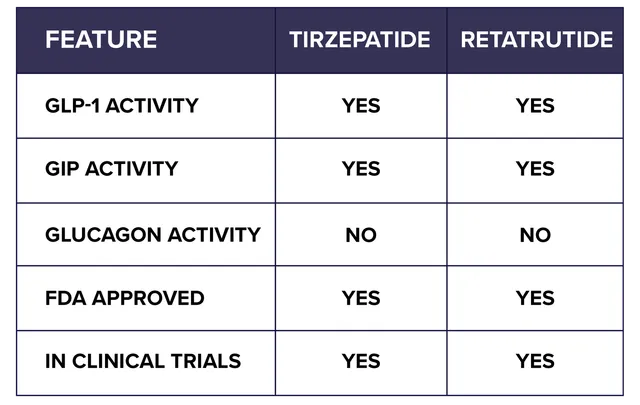
Retatrutide vs tirzepatide — dual vs triple agonist mechanism
The foundational difference in the retatrutide vs tirzepatide comparison is receptor targeting. Tirzepatide is a dual agonist — it activates two hormone receptors: GLP-1 (glucagon-like peptide-1) and GIP (glucose-dependent insulinotropic polypeptide). This dual mechanism suppresses appetite, slows gastric emptying, improves insulin sensitivity, and promotes fat metabolism through two complementary hormonal pathways.
Retatrutide goes further. It is a triple agonist — activating GLP-1, GIP, and the glucagon receptor. This third target is the distinguishing feature. Glucagon receptor activation increases energy expenditure and promotes fat oxidation directly, adding a thermogenic component that neither semaglutide nor tirzepatide possess. In theory, this means retatrutide does not rely solely on appetite suppression and reduced food intake to drive weight loss — it also increases the rate at which the body burns stored fat.
When comparing retatrutide vs tirzepatide, the simplest way to think about it: tirzepatide reduces weight primarily by reducing how much you eat and improving how your body handles what you eat. Retatrutide does both of those things and additionally increases how much energy your body burns at rest. This triple mechanism is why retatrutide has produced the highest weight loss figures seen in any obesity drug trial to date.
Retatrutide vs tirzepatide weight loss — what the trials show
This is where the retatrutide vs tirzepatide conversation gets most attention — and where the most caution is needed when interpreting data. Both drugs produce extraordinary results, but they were studied in different trial designs, different populations, and over different timeframes.
| Metric | Tirzepatide (SURMOUNT) | Retatrutide (TRIUMPH) |
|---|---|---|
| Receptors targeted | GLP-1 + GIP (dual) | GLP-1 + GIP + Glucagon (triple) |
| Max weight loss (trial) | ~20–22% body weight | ~28.7% body weight |
| Trial duration | 72 weeks | 48 weeks (Phase 3) |
| Liver fat reduction | Significant | Up to 86% reduction |
| Approval status (UK) | MHRA approved (Mounjaro) | Phase 3 trials (not approved) |
| Manufacturer | Eli Lilly | Eli Lilly |
| Administration | Once weekly injection | Once weekly injection |
The headline figures in the retatrutide vs tirzepatide comparison are striking: retatrutide achieved nearly 29 percent body weight reduction in 48 weeks, while tirzepatide achieved 20 to 22 percent over 72 weeks. However, these are not head-to-head results from the same trial. Direct comparison requires caution because patient populations, baseline weights, and study designs differed. What can be said with reasonable confidence is that retatrutide, at maximum doses, produces weight loss that approaches and may exceed bariatric surgery outcomes.
Retatrutide vs tirzepatide — liver fat reduction
One of the most clinically significant findings in the retatrutide vs tirzepatide comparison is liver fat reduction. Non-alcoholic fatty liver disease (NAFLD) affects a large proportion of individuals with obesity and is a serious health risk in its own right. Both drugs reduce liver fat, but retatrutide’s glucagon receptor activity appears to confer a particular advantage here.
Trial data from the TRIUMPH programme showed retatrutide reducing liver fat by up to 86 percent from baseline — a degree of improvement previously seen only after bariatric surgery. Tirzepatide also produces meaningful liver fat reduction, but the magnitude reported in SURMOUNT substudies, while significant, does not reach the same level. For patients with significant NAFLD, this difference in the retatrutide vs tirzepatide comparison may be clinically important.
Retatrutide vs tirzepatide side effects compared
Both medications share the gastrointestinal side effects common to all GLP-1 receptor agonists: nausea, vomiting, diarrhoea, and constipation. These are typically worst during dose escalation and improve over time. Neither drug has shown unexpected safety signals in trials to date, though both carry the standard warnings for pancreatitis and gallbladder disease that apply to the entire GLP-1 class.
The key difference in the retatrutide vs tirzepatide side effect profile comes from retatrutide’s glucagon receptor activation. Glucagon has effects on heart rate and blood pressure, and some trial participants on retatrutide showed modest increases in resting heart rate. Whether this translates to any meaningful cardiovascular concern over long-term use is not yet established — dedicated cardiovascular outcome trials are underway but have not reported results.
Neither retatrutide nor tirzepatide should be used during pregnancy. Both are contraindicated in patients with a personal or family history of medullary thyroid carcinoma or multiple endocrine neoplasia syndrome type 2. Always discuss your complete medical history with your prescriber before starting any GLP-1 medication.
Retatrutide vs tirzepatide — UK availability and approval
This is the most practically important difference in the retatrutide vs tirzepatide comparison for UK patients right now. Tirzepatide is available in the UK under the brand name Mounjaro. It has received MHRA approval and NICE has recommended it for obesity treatment, making it accessible through both NHS and private prescribing pathways.
Retatrutide, by contrast, is still in Phase 3 clinical trials as of mid-2026. It has not received MHRA approval, and realistic estimates place potential UK availability in late 2027 or 2028 at the earliest, assuming trial data supports a regulatory submission and the MHRA review proceeds on standard timelines. Patients interested in retatrutide should be aware that any product currently marketed as retatrutide outside of clinical trial settings is not a regulated pharmaceutical product.
Retatrutide vs tirzepatide — cost and accessibility
Tirzepatide is currently priced as a premium obesity treatment in the UK private market, with monthly costs varying by dose and supplier. NHS access is expanding but remains subject to eligibility criteria and regional commissioning decisions. When retatrutide eventually reaches the UK market, its pricing will depend on negotiations between Eli Lilly and NHS England, as well as NICE cost-effectiveness assessments.
It is worth noting that both drugs are manufactured by the same company — Eli Lilly — which means they are unlikely to be positioned as direct competitors. More likely, they will be offered as sequential options within a treatment pathway, with tirzepatide as a first-line option and retatrutide potentially reserved for patients who need more aggressive weight loss or who have not responded adequately to dual agonist therapy.
Retatrutide vs tirzepatide — who each medication may suit best
Tirzepatide may be better suited if you:
- Need a treatment that is available now in the UK, with an established safety profile
- Have type 2 diabetes alongside obesity, as tirzepatide has strong glycaemic control data
- Are looking for a dual-agonist with robust long-term evidence from multiple Phase 3 trials
- Prefer a medication that has been through full NICE appraisal and is NHS-accessible
Retatrutide may be better suited if you:
- Need more aggressive weight loss than dual-agonist therapy has delivered
- Have significant non-alcoholic fatty liver disease that requires substantial liver fat reduction
- Have not achieved adequate results on semaglutide or tirzepatide and need a next-line option
- Are willing to wait for regulatory approval or access through a clinical trial
The retatrutide vs tirzepatide question is not about which drug is better in absolute terms — both are extraordinary. The question is which drug is right for your specific clinical situation, your timeline, and your goals.
Evidence-based perspectiveCommon questions — retatrutide vs tirzepatide
Explore your GLP-1 options with Mymetabolism.
HPLC-verified at 99% purity, COA on every batch, free UK shipping. Browse our full range of GLP-1 peptides and start your weight management journey today.
Browse products →