
Wegovy vs Mounjaro — which GLP-1 medication is right for you?
Wegovy vs Mounjaro is the comparison every UK patient researching GLP-1 treatment eventually faces — two powerful weight loss medications that work differently, produce different levels of results in clinical trials, and yet share a remarkably similar patient experience day to day. Both reduce appetite, both slow gastric emptying, both produce significant weight loss, and both come with similar side effect profiles. So what actually separates them, and how do you decide which one is right for you?
This guide compares Wegovy vs Mounjaro across every dimension that matters to a UK patient in 2026: how they work, weight loss results, side effects, dosing schedules, cost, and availability. The information here is based on published clinical trial data and is consistent with general prescribing guidance from the NHS. This is not medical advice — always consult your prescriber before starting or switching medication.
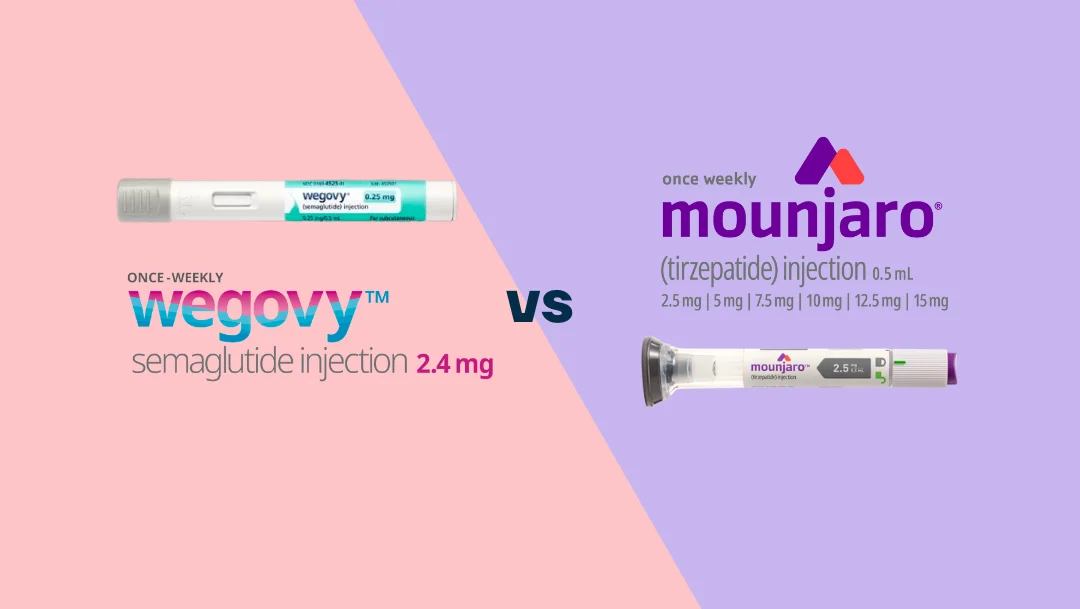
Wegovy vs Mounjaro — at a glance
| Factor | Wegovy (semaglutide) | Mounjaro (tirzepatide) |
|---|---|---|
| Active ingredient | Semaglutide | Tirzepatide |
| Mechanism | GLP-1 receptor agonist (single) | GIP + GLP-1 dual receptor agonist |
| Manufacturer | Novo Nordisk | Eli Lilly |
| Average weight loss | 15–17% of body weight | 20–25% of body weight |
| Injection frequency | Once weekly | Once weekly |
| Dose range | 0.25 mg → 2.4 mg | 2.5 mg → 15 mg |
| Titration period | 16–20 weeks | 20–28 weeks |
| Main side effects | Nausea, constipation, diarrhoea | Nausea, constipation, diarrhoea |
| UK availability | Available (supply improving) | Available (limited supply) |
| Approximate monthly cost | £150–£250 | £180–£300 |
Wegovy vs Mounjaro — how they work differently
Wegovy: the single-action GLP-1
Wegovy contains semaglutide, which mimics a natural gut hormone called GLP-1 (glucagon-like peptide-1). When you eat, your gut releases GLP-1 to signal fullness to your brain, slow gastric emptying, and stimulate insulin release. Semaglutide activates the same receptor, producing these effects at a sustained, therapeutic level. In the Wegovy vs Mounjaro comparison, semaglutide is the more established molecule — it has been studied extensively since 2012 and has a longer track record.
Mounjaro: the dual-action GLP-1 + GIP
Mounjaro contains tirzepatide, which mimics two gut hormones simultaneously — GLP-1 and GIP (glucose-dependent insulinotropic polypeptide). GIP plays a complementary role in insulin regulation, fat metabolism, and appetite signalling. By activating both receptors, tirzepatide produces effects that are additive — greater appetite suppression, enhanced insulin sensitivity, and improved fat metabolism compared to GLP-1 activation alone. This dual mechanism is the primary reason why, in the Wegovy vs Mounjaro comparison, Mounjaro consistently produces greater average weight loss.
Think of Wegovy vs Mounjaro as one engine versus two engines. Wegovy activates one hormonal pathway (GLP-1) that reduces appetite and improves metabolism. Mounjaro activates two hormonal pathways (GLP-1 + GIP) that do the same thing through complementary mechanisms. Two engines generally produce more thrust — which is why Mounjaro’s average weight loss numbers are higher. But some patients respond exceptionally well to the single engine and do not need the second.
Wegovy vs Mounjaro — weight loss results
The weight loss data is where the Wegovy vs Mounjaro comparison gets most interesting — and most nuanced. Clinical trial averages tell a clear story, but individual responses tell a much more varied one.
| Metric | Wegovy (semaglutide 2.4 mg) | Mounjaro (tirzepatide 15 mg) |
|---|---|---|
| Average total body weight loss | 15–17% | 20–25% |
| Patients losing >10% body weight | ~70% | ~85% |
| Patients losing >20% body weight | ~30–35% | ~55–60% |
| Average weight loss (kg) for 100 kg patient | 15–17 kg | 20–25 kg |
| Time to maximum effect | 12–16 months | 12–18 months |
On average, Mounjaro produces approximately 5–8 percentage points more weight loss than Wegovy. But averages hide enormous individual variation. Some patients lose 25% of their body weight on Wegovy. Some patients lose only 12% on Mounjaro. The medication that produces the best results for you is the one that your body responds to — not the one with the better average.
Clinical perspectiveWegovy vs Mounjaro — side effects compared
The side effect profiles of Wegovy vs Mounjaro are remarkably similar. Both primarily affect the gastrointestinal system, and both are most pronounced during the dose escalation phase.
| Side effect | Wegovy | Mounjaro |
|---|---|---|
| Nausea | 40–45% | 35–45% |
| Diarrhoea | 25–30% | 15–20% |
| Constipation | 20–25% | 20–30% |
| Vomiting | 15–25% | 10–18% |
| Injection site reactions | 5–8% | 3–6% |
| Fatigue | 10–15% | 8–12% |
| Headache | 10–14% | 8–12% |
The key takeaway from the Wegovy vs Mounjaro side effect comparison is that both medications produce broadly similar gastrointestinal effects, and individual tolerance varies far more than the averages suggest. Some patients tolerate Wegovy perfectly and struggle with Mounjaro. Others find the opposite. The only way to know how your body responds to either medication is to try it — which is why switching between the two is a legitimate option if side effects on one are intolerable.
Wegovy vs Mounjaro — dosing schedules
Wegovy dosing (semaglutide)
| Dose | Duration | Purpose |
|---|---|---|
| 0.25 mg weekly | Weeks 1–4 | Titration — body adjusts |
| 0.5 mg weekly | Weeks 5–8 | Titration |
| 1.0 mg weekly | Weeks 9–12 | Titration — weight loss begins |
| 1.7 mg weekly | Weeks 13–16 | Titration |
| 2.4 mg weekly | Week 17 onwards | Maintenance — full therapeutic dose |
Mounjaro dosing (tirzepatide)
| Dose | Duration | Purpose |
|---|---|---|
| 2.5 mg weekly | Weeks 1–4 | Titration — body adjusts |
| 5.0 mg weekly | Weeks 5–8 | Titration — effects increasing |
| 7.5 mg weekly | Weeks 9–12 | Mid-range therapeutic dose |
| 10 mg weekly | Weeks 13–16 | Higher therapeutic dose |
| 12.5 mg weekly | Weeks 17–20 | Near-maximum dose |
| 15 mg weekly | Week 21 onwards | Maximum therapeutic dose |
In the Wegovy vs Mounjaro comparison, Mounjaro has more dose steps and a longer titration period. This can be an advantage — more granularity means your prescriber can find the dose that balances effectiveness with tolerability more precisely. Some patients achieve their target weight on 7.5 mg or 10 mg of Mounjaro without needing to reach the maximum 15 mg dose, which means fewer side effects and lower cost.
Wegovy vs Mounjaro — cost and UK availability
| Factor | Wegovy | Mounjaro |
|---|---|---|
| Private prescription (monthly) | £150–£250 | £180–£300 |
| NHS availability | Limited — strict eligibility | Limited — strict eligibility |
| Research peptide (monthly) | Lower cost | Slightly higher cost |
| Supply stability (2026) | Improving — supply shortages easing | More limited — still scaling up |
In the Wegovy vs Mounjaro cost comparison, Wegovy is generally the more affordable and more accessible option in the UK as of 2026. Semaglutide has been available longer, supply chains are more established, and more providers offer it. Tirzepatide supply is improving but remains more constrained. For patients sourcing research-grade peptides, the cost difference narrows but tirzepatide remains slightly more expensive per dose.
Wegovy vs Mounjaro — which suits you?
Wegovy may be better if:
- You want the most established option: Semaglutide has a longer clinical track record and more long-term safety data
- Budget is a primary concern: Wegovy is typically £30–£70 cheaper per month than Mounjaro
- Availability matters: Wegovy is more consistently available in the UK than Mounjaro in 2026
- You have moderate weight loss goals: If you need to lose 10–15% of body weight, Wegovy is more than sufficient for most patients
- You have already had success with semaglutide: If Ozempic or another semaglutide product has worked well, Wegovy is the same active ingredient at a higher dose
Mounjaro may be better if:
- You have significant weight to lose: If your target is 20%+ body weight loss, Mounjaro’s higher average results may give you a better chance of reaching that goal
- You have type 2 diabetes or strong insulin resistance: The dual GIP+GLP-1 mechanism provides enhanced blood sugar control that may benefit metabolic health beyond weight loss alone
- Semaglutide has not produced adequate results: If you have plateaued or responded poorly to semaglutide, the different mechanism of tirzepatide may produce a better response
- You want the most weight loss possible: Clinical data is clear — on average, Mounjaro produces greater weight loss than Wegovy at maximum doses
- You want more dosing flexibility: Six dose levels versus five gives your prescriber more room to find your optimal dose
The Wegovy vs Mounjaro decision should be made with your prescriber based on your individual health profile, weight loss goals, medical history, and budget. Both are highly effective medications that produce life-changing results for the majority of patients. The “best” medication is the one that works for your specific body and circumstances — and the only way to know that is through informed discussion with a qualified professional.
Wegovy vs Mounjaro is not a question with a universal answer. It is a question with your answer — and finding it requires understanding both medications, being honest about your goals and budget, and working with a prescriber who can guide you through the options.
Mymetabolism guidanceCommon questions — Wegovy vs Mounjaro
Explore your GLP-1 options with Mymetabolism.
We supply both semaglutide and tirzepatide — HPLC-verified at 99% purity, COA on every batch, free UK shipping. Explore your options and find the right fit.
Browse products →