
The CagriReta dosing guide — 6 essential steps to get it right.
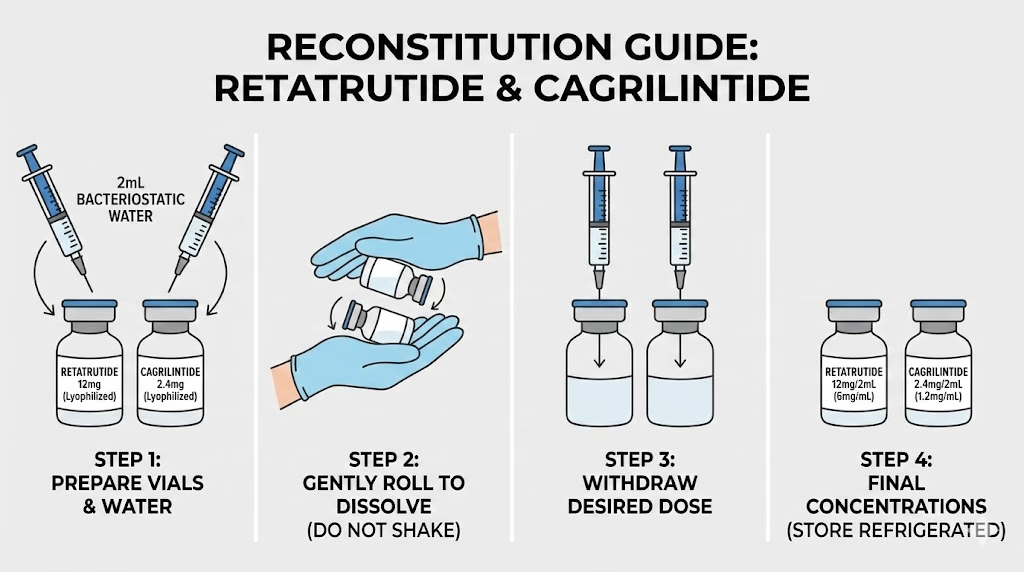
A clear CagriReta dosing guide matters because this treatment combines two compounds — cagrilintide and semaglutide — each following their own titration pattern. Getting the dosing right from the start makes the difference between a smooth, manageable experience and unnecessary side effects.
This guide walks through the standard CagriReta dosing schedule, what to expect at each stage, and the most common mistakes to avoid. All guidance follows standard titration principles used for cagrilintide and semaglutide individually, alongside general NHS medicines guidance. Contact our 24/7 support team with any questions about your dosing schedule.
CagriReta dosing guide — step 1: why titration matters
Both cagrilintide and semaglutide are titrated gradually rather than started at a full therapeutic dose. This is not arbitrary caution — it directly reduces the gastrointestinal side effects that are the most common reason people discontinue GLP-1 treatments.
Starting at a low dose and increasing gradually gives your digestive system, appetite regulation, and gastric emptying rate time to adjust. Rushing this process does not speed up weight loss results — it only increases the likelihood of severe side effects that could derail your treatment entirely.
CagriReta dosing guide — step 2: the starting dose
A CagriReta dosing guide typically begins with the lowest available dose of both compounds for the first 4 weeks. This introductory phase exists purely to let your body adapt — meaningful weight loss effects are usually minimal at this stage.
Both compounds are injected at the same low starting level, each at its own separate injection site as outlined in our injection technique guide. This foundational phase should never be skipped, even if you feel ready to progress faster.
CagriReta dosing guide — step 3: the full titration schedule
A typical CagriReta dosing guide follows a 4-week interval between dose increases for both compounds, continuing until the target maintenance dose is reached. The full schedule generally spans 12 to 20 weeks depending on the specific protocol.
| Phase | Duration | Dose level |
|---|---|---|
| Phase 1 | Weeks 1–4 | Starting dose (both compounds) |
| Phase 2 | Weeks 5–8 | First increase |
| Phase 3 | Weeks 9–12 | Second increase |
| Phase 4 | Weeks 13–16 | Third increase (if needed) |
| Maintenance | Week 17 onwards | Target dose reached — held long-term |
This CagriReta dosing guide describes a typical titration pattern, but your specific schedule should always come from your prescriber based on your individual health profile, response, and tolerability.
Never adjust your dose independently without medical guidance.
CagriReta dosing guide — step 4: what to expect at each stage
Understanding the pattern of side effects at each titration stage helps you prepare rather than panic. Early doses typically bring the mildest symptoms — some nausea, mild appetite reduction, and occasional fatigue.
Each dose increase tends to bring a brief resurgence of symptoms lasting 1 to 2 weeks before easing again. By the time you reach your maintenance dose, most people report that side effects have stabilised significantly compared to the earlier titration phases.
CagriReta dosing guide — step 5: finding your maintenance dose
Not everyone needs to reach the highest available dose. The goal of any CagriReta dosing guide is finding the lowest effective dose that delivers your individual weight loss and health goals with side effects you can comfortably manage.
Many patients achieve excellent, sustained results at a dose below the maximum and choose to remain there rather than continuing to titrate upward. This decision should always be made collaboratively with your prescriber based on your progress and how you are tolerating treatment.
CagriReta dosing guide — step 6: common mistakes to avoid
- Increasing too quickly: Skipping the recommended 4-week interval significantly raises the risk of severe gastrointestinal side effects without any benefit to weight loss speed.
- Skipping doses to “catch up” later: Doubling up after a missed dose is never recommended — follow standard missed-dose guidance instead.
- Not tracking injection sites: Failing to rotate sites for both compounds can lead to lipodystrophy at overused injection points.
- Ignoring persistent side effects: Pushing through severe symptoms rather than discussing them with your prescriber can lead to unnecessary discontinuation of an otherwise effective treatment.
- Comparing your schedule to others: Individual titration speed and maintenance dose vary significantly — what works for someone else’s CagriReta dosing guide may not be right for you.
The best CagriReta dosing guide is not the one that gets you to the highest dose fastest. It is the one that gets you to your goals with side effects you can live with, at a pace your body can genuinely handle.
Our clinical guidanceThis CagriReta dosing guide provides general educational information about typical titration patterns. Your actual dosing schedule must be determined and monitored by your prescriber, based on your individual health history and response.
Explore our CagriReta product page for full details, or read our guide on how to inject CagriReta on our blog. Compare with retatrutide or read patient reviews.
This article is for informational purposes only and does not constitute medical advice. Always consult a qualified healthcare provider before starting, stopping, or adjusting any medication dosing schedule.
Common questions — CagriReta dosing guide
Start your CagriReta journey with confidence.
UK-based, MHRA-compliant supply with 24/7 support to guide you through every stage of your dosing schedule.
Explore CagriReta →