
NAD+ and weight loss — 7 critical facts.
NAD+ and weight loss is one of the most searched metabolic health topics of 2026, driven by a flood of marketing claims that range from plausible to actively misleading. The honest answer sits somewhere between “magic fat burner” (it isn’t) and “completely useless” (it isn’t that either). NAD+ is a genuinely important metabolic cofactor that influences fat oxidation in meaningful ways — just not in the way most of the marketing suggests.
This guide covers the complete NAD+ and weight loss evidence picture: what NAD+ actually does in fat metabolism, what the human clinical trials show, why obesity depletes NAD+, and why the compound is most valuable as part of an active metabolic protocol rather than as a standalone intervention. General nutritional information is available through the British Dietetic Association.
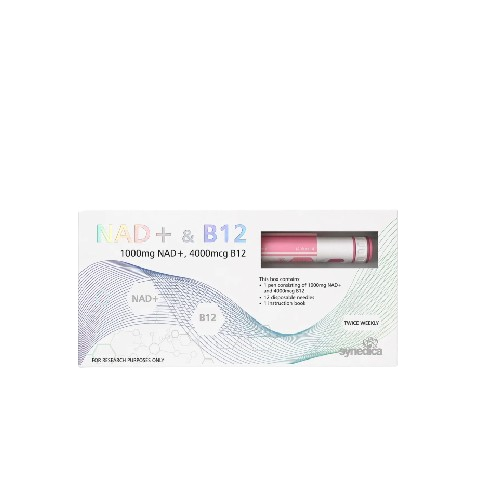
Research-grade NAD+ with transparent sourcing and COA documentation.
Explore NAD+ →NAD+ and Weight Loss — fact 1: what NAD+ actually is
Understanding the NAD+ and weight loss relationship starts with understanding what NAD+ is. Nicotinamide adenine dinucleotide (NAD+) is a coenzyme present in every living cell. It is not a hormone, a drug, or a signalling molecule in the conventional sense — it is a fundamental metabolic cofactor involved in over 500 enzymatic reactions. Think of it as a cellular workhorse rather than a cellular messenger.
NAD+ serves two primary roles relevant to NAD+ and weight loss. First, it is the essential electron carrier in the electron transport chain — the mitochondrial process that converts fuel (including fat) into ATP energy. Second, it is the required substrate for sirtuins (SIRT1-7), a family of enzymes that regulate fat oxidation, mitochondrial biogenesis, insulin sensitivity, and DNA repair. Both roles are directly relevant to metabolic health. Neither creates weight loss independently of the conditions that drive fat oxidation in the first place.
NAD+ and Weight Loss — fact 2: how it affects fat metabolism
The mechanistic case for NAD+ and weight loss is genuinely compelling at the cellular level. SIRT1 activation — which requires NAD+ — promotes lipolysis (the breakdown of stored fat into free fatty acids) and inhibits lipogenesis (the synthesis of new fat from dietary calories) in adipose tissue. SIRT3 improves mitochondrial respiratory efficiency and increases fatty acid oxidation in skeletal muscle. AMPK — the cellular energy sensor that shifts metabolism toward fat burning when energy is low — partners with NAD+ signalling to amplify these effects.
These are real, well-characterised mechanisms. The problem for NAD+ and weight loss claims is the conditional nature of these effects: sirtuins are most active during fasting or caloric restriction, not at caloric maintenance or surplus. Raising NAD+ levels improves how efficiently the body responds to an energy deficit — it doesn’t create the deficit itself.
| NAD+ mechanism | Effect | Conditional on |
|---|---|---|
| SIRT1 activation | Promotes fat breakdown, inhibits fat storage | Caloric deficit or fasting |
| SIRT3 activation | Mitochondrial efficiency, fatty acid oxidation | Energy deficit state |
| AMPK partnership | Shifts metabolism toward fat burning | Low cellular energy (deficit) |
| Electron transport | Converts fat to ATP energy | Active fat mobilisation required |
NAD+ and Weight Loss — fact 3: the honest evidence summary
The most useful framing of the NAD+ and weight loss evidence comes from a direct quote from one of the more rigorous 2026 independent reviews: “NAD+ precursors are not weight-loss supplements. The marketing framing — ‘boost metabolism’, ‘activate fat-burning genes’, ‘rev up mitochondria’ — is technically accurate but functionally misleading. Yes, NMN and NR raise NAD+ levels. Yes, elevated NAD+ improves mitochondrial efficiency and sirtuin activity. But those improvements do not translate into meaningful fat loss unless you’re already in a caloric deficit or fasting state.”
This is the essential NAD+ and weight loss distinction: the mechanism is real, the standalone weight loss claim is not. NAD+ belongs in protocols designed around metabolic optimisation during intentional caloric restriction — not as a passive intervention that produces fat loss without an accompanying deficit. Understanding this distinction is what separates informed NAD+ use from expensive disappointment.
Anyone selling NAD+ as a standalone weight loss intervention without this caveat is either uninformed or being deliberately misleading. The compound has genuinely valuable metabolic properties — but they manifest during active caloric restriction, not at maintenance intake. If you’re not already losing weight through diet, exercise, or pharmacological intervention, NAD+ will not change that.
NAD+ and Weight Loss — fact 4: what human trials actually show
The human clinical evidence for NAD+ and weight loss is more modest than animal study extrapolations suggest, but more interesting than “no effect” dismissals claim. The key studies:
2021 Science RCT (Yoshino et al.): Overweight or obese postmenopausal women given 250mg NMN twice daily for 10 weeks. Result: significantly improved skeletal muscle insulin sensitivity — the primary metabolic endpoint. Direct weight loss was not a primary outcome and was not demonstrated. This is the most cited human NMN study and its finding is genuinely important: better insulin sensitivity means fat cells respond more appropriately to insulin signals, which supports body composition improvement when combined with dietary changes.
2022 Igarashi et al.: Older men given NMN supplementation showed elevated blood NAD+ levels and improvements in muscle measures, confirming that oral NMN does meaningfully raise circulating NAD+ in humans.
2025 systematic review (Vinten KT et al.): Reviewed the NAD+ precursor supplementation literature in the context of human ageing. Conclusion: increases in NAD+ metabolites are reproducible, while functional and clinical outcomes remain heterogeneous. Direct weight loss evidence remains limited.
The honest summary: human data confirms that NAD+ precursors raise NAD+ levels and improve insulin sensitivity. Direct weight loss in controlled human trials is not established as a reliable primary outcome.
NAD+ and Weight Loss — fact 5: obesity depletes NAD+
One of the most interesting and clinically relevant NAD+ and weight loss findings is the bidirectional relationship between NAD+ status and body weight. A systematic review published in a peer-reviewed metabolic journal found that NAD+ and sirtuin gene expression are significantly downregulated in obese individuals compared to lean controls. More strikingly, levels progressively increase during weight loss programmes — suggesting that NAD+ depletion is both a consequence of obesity and a factor that may perpetuate metabolic inefficiency.
This relationship has a clear implication for NAD+ and weight loss use: supplementation may be most valuable not at baseline weight in a person not yet losing weight, but during an active weight loss phase when NAD+ stores are being most actively depleted by the metabolic demands of fat mobilisation. This is precisely the scenario created by aggressive interventions like retatrutide — high fat mobilisation rates creating high NAD+ demand. For the specific application of NAD+ alongside retatrutide, read our guide on NAD+ and retatrutide.
NAD+ and Weight Loss — fact 6: it works during deficit, not instead of it
The conditional nature of NAD+ and weight loss effects — that they manifest during caloric deficit rather than at maintenance — has a practical implication that is worth being explicit about. NAD+ supplementation alongside a caloric deficit may:
- Improve the efficiency of fat oxidation, meaning more of the caloric deficit comes from fat rather than muscle
- Support lean mass preservation through SIRT1/SIRT3-mediated muscle protection during restriction
- Improve insulin sensitivity, which supports better partitioning of dietary calories toward muscle glycogen rather than fat storage
- Reduce exercise-related fatigue and improve mitochondrial recovery between training sessions
NAD+ supplementation without any accompanying deficit may:
- Raise circulating NAD+ levels (confirmed by human trials)
- Improve systemic insulin sensitivity modestly
- Provide cellular energy support and DNA repair benefits unrelated to weight
- Produce minimal to no direct fat loss
NAD+ and Weight Loss — fact 7: when NAD+ genuinely makes sense
Given the honest evidence for NAD+ and weight loss, the scenarios where supplementation genuinely makes sense are clear:
- Alongside aggressive pharmacological weight loss — particularly retatrutide or tirzepatide, where rapid fat mobilisation creates high NAD+ demand through beta-oxidation. This is the most mechanistically justified application of NAD+ in a weight loss context.
- During caloric restriction with exercise — NAD+ supports both the mitochondrial demands of training and the lean mass preservation goals of a cutting phase.
- As part of a longer-term metabolic health protocol — for people with confirmed metabolic syndrome, insulin resistance, or age-related metabolic decline where improved insulin sensitivity and mitochondrial function are the primary goals.
- Not as a standalone weight loss intervention — without an accompanying deficit or active fat mobilisation protocol, the metabolic mechanisms that make NAD+ useful simply aren’t activated at a level that produces meaningful fat loss.
NAD+ and weight loss works — just not the way most marketing claims. It doesn’t burn fat. It makes your mitochondria better at burning fat when you’re already burning it. That distinction matters enormously for anyone deciding whether NAD+ belongs in their protocol.
Our research guidanceFor the most evidence-backed fat loss protocol, explore our Synedica Retatrutide product page — the compound that creates the active fat mobilisation environment where NAD+ is most valuable. Explore our NAD+ product page, or read our guide on NAD+ and retatrutide together.
This article is for informational and research purposes only. NAD+ supplementation is not a licensed medicine and claims about its weight loss effects have not been evaluated by the MHRA. The evidence reviewed reflects published human clinical trials as of September 2026. Individual responses to supplementation vary. Always consult a qualified healthcare provider before beginning any supplementation protocol.
Common questions — NAD+ and weight loss
Want results that don’t require a deficit? Explore Synedica Retatrutide.
The #1 ranked fat loss compound by Phase 3 evidence — creates the active metabolic environment where NAD+ works best.
Explore Synedica Retatrutide →