
Retatrutide dosing guide — recommended doses and what to expect.
Retatrutide dosing guide information is in high demand because retatrutide is the most potent weight loss peptide ever studied in clinical trials — producing average weight losses of up to 24% of total body weight at the highest dose. As the world’s first triple-receptor agonist (GLP-1 + GIP + glucagon), retatrutide represents a fundamentally new approach to obesity treatment that goes beyond what semaglutide and tirzepatide can achieve. But with greater potency comes a greater need to understand how to dose it correctly, what to expect at each level, and how to manage the side effects that come with a medication this powerful.
This retatrutide dosing guide covers everything currently known from published phase 2 trial data: the dose levels tested, the titration schedule used in trials, the weight loss achieved at each dose, the side effect profile, and how retatrutide compares to other GLP-1 medications. The information here is based on published clinical trial data from Eli Lilly’s phase 2 study and is consistent with general guidance from the NHS on weight management. Retatrutide is not yet approved for clinical use — this guide is for informational purposes.
Retatrutide dosing guide — what is retatrutide?
Retatrutide is a triple-receptor agonist developed by Eli Lilly that simultaneously activates three hormone receptors involved in metabolism and appetite regulation. Understanding this mechanism is essential context for any retatrutide dosing guide because the triple action is what makes it both more potent and more complex than earlier GLP-1 medications:
- GLP-1 receptor: Reduces appetite, slows gastric emptying, and improves insulin sensitivity — the same pathway targeted by semaglutide (Wegovy/Ozempic)
- GIP receptor: Enhances insulin response, improves fat metabolism, and works synergistically with GLP-1 — the same additional pathway targeted by tirzepatide (Mounjaro)
- Glucagon receptor: This is what makes retatrutide unique. Glucagon receptor activation increases energy expenditure, promotes fat breakdown (lipolysis), and reduces liver fat storage. No other approved weight loss medication activates this pathway.
If semaglutide is a single engine and tirzepatide is a twin engine, retatrutide is a triple engine. The addition of glucagon receptor activation adds a metabolic dimension that the other medications simply do not have — and the clinical trial results reflect it.
Mechanism comparisonRetatrutide dosing guide — the dose levels tested
The phase 2 clinical trial (published in the New England Journal of Medicine) tested four retatrutide dose levels against placebo over 48 weeks. This retatrutide dosing guide reflects the doses and protocols used in that trial:
| Dose group | Target dose | Starting dose | Escalation |
|---|---|---|---|
| Low dose | 1 mg weekly | 1 mg (no titration) | None — fixed dose |
| Mid dose | 4 mg weekly | 2 mg for 4 weeks | → 4 mg from week 5 |
| High dose | 8 mg weekly | 2 mg → 4 mg → 8 mg | Monthly increases |
| Maximum dose | 12 mg weekly | 2 mg → 4 mg → 8 mg → 12 mg | Monthly increases |
These doses are from phase 2 trial data. Phase 3 trials — which will determine the final approved doses — are ongoing. The approved retatrutide dosing guide may differ from what is presented here. If you are using research-grade retatrutide, understand that you are working with preliminary dosing data that has not yet been validated through the full regulatory approval process.
Retatrutide dosing guide — titration schedule
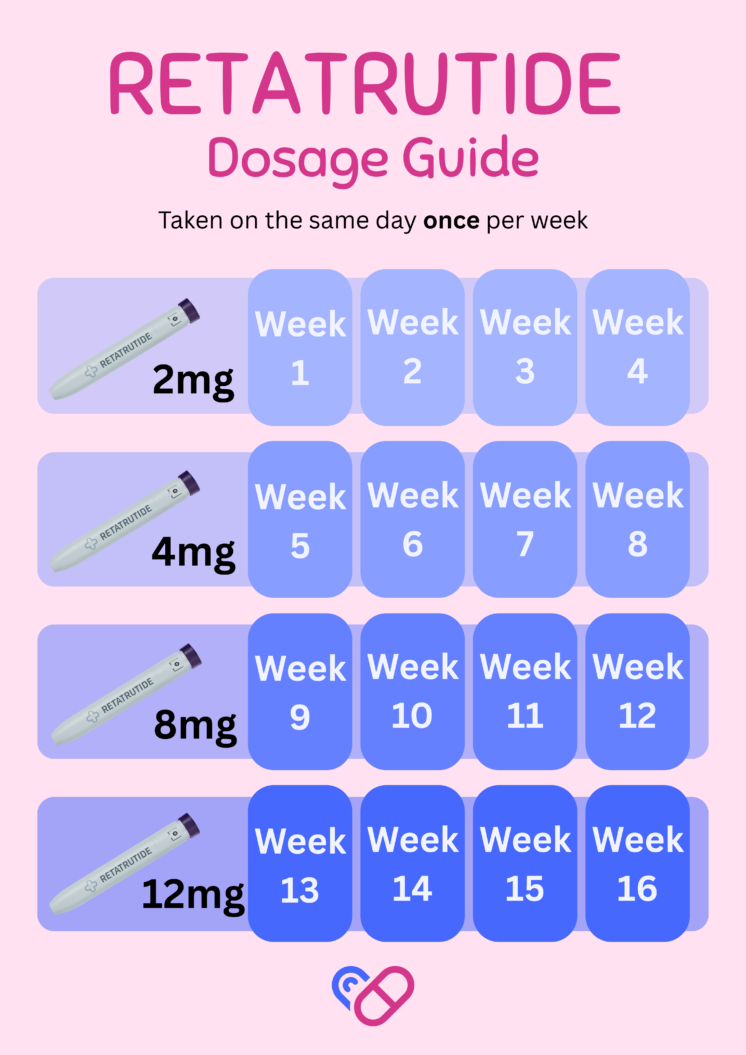
Like all GLP-1 class medications, the retatrutide dosing guide follows a gradual titration to minimise gastrointestinal side effects. For the 12 mg target dose — the most effective level tested — the schedule used in clinical trials was:
| Period | Dose | Purpose |
|---|---|---|
| Weeks 1–4 | 2 mg weekly | Initial adjustment — body adapts to triple-receptor activation |
| Weeks 5–8 | 4 mg weekly | First escalation — appetite effects become noticeable |
| Weeks 9–12 | 8 mg weekly | Therapeutic range — significant appetite suppression and weight loss |
| Weeks 13+ | 12 mg weekly | Maximum dose — full therapeutic effect for remainder of treatment |
The total titration period to reach the maximum dose in this retatrutide dosing guide is approximately 12 weeks — slightly faster than the Wegovy schedule (16–20 weeks) because retatrutide uses fewer intermediate dose steps. However, the monthly escalation pace is consistent with the general principle of allowing 4 weeks of adaptation at each level before increasing.
Retatrutide dosing guide — weight loss results by dose
The phase 2 trial results are what generated the extraordinary interest in retatrutide — and they remain the most impressive weight loss figures ever reported for a pharmacological intervention. This section of the retatrutide dosing guide presents the data from the 48-week trial:
| Dose | Average weight loss (%) | Average weight loss (kg, 100 kg start) | Patients losing >15% |
|---|---|---|---|
| Placebo | -2.1% | -2.1 kg | ~5% |
| 1 mg | -8.7% | -8.7 kg | ~25% |
| 4 mg | -17.1% | -17.1 kg | ~55% |
| 8 mg | -22.8% | -22.8 kg | ~75% |
| 12 mg | -24.2% | -24.2 kg | ~83% |
At the 12 mg dose, participants lost an average of 24.2% of their body weight in 48 weeks — and the weight loss curve had not fully plateaued, suggesting that longer treatment could produce even greater results. These numbers exceed anything achieved by semaglutide or tirzepatide in comparable trial durations.
Phase 2 trial dataA key finding in this retatrutide dosing guide is that the 8 mg dose produced 22.8% weight loss — only 1.4 percentage points less than the 12 mg dose, but with a lower side effect burden. For patients who tolerate 8 mg well but experience significant GI effects at 12 mg, remaining at 8 mg may offer the best balance of efficacy and tolerability. This is a discussion point for future prescribers once the medication reaches market.
Retatrutide dosing guide — side effects at each level
The side effect profile of retatrutide is broadly similar to other GLP-1 medications, with gastrointestinal effects dominating. This retatrutide dosing guide includes the reported rates from the phase 2 trial:
| Side effect | 4 mg | 8 mg | 12 mg |
|---|---|---|---|
| Nausea | 22% | 31% | 45% |
| Diarrhoea | 18% | 22% | 28% |
| Vomiting | 8% | 12% | 18% |
| Constipation | 12% | 18% | 25% |
| Decreased appetite | 15% | 20% | 28% |
Side effects were most pronounced during the dose escalation weeks of the retatrutide dosing guide schedule and tended to improve as the body adjusted at each level. Most side effects were rated as mild to moderate. Discontinuation due to adverse events was low across all dose groups, suggesting that the titration approach effectively managed tolerability for the majority of participants.
Because retatrutide activates the glucagon receptor in addition to GLP-1 and GIP, it may produce some effects that are not seen with semaglutide or tirzepatide. Glucagon receptor activation can increase heart rate slightly, affect liver enzyme levels, and alter lipid metabolism. The phase 2 trial reported no serious safety concerns related to these effects, but long-term safety data from phase 3 trials is not yet available. This is an important caveat for any retatrutide dosing guide.
Retatrutide dosing guide — how it compares
| Medication | Mechanism | Max dose | Average weight loss | Approval status |
|---|---|---|---|---|
| Semaglutide (Wegovy) | GLP-1 single agonist | 2.4 mg | 15–17% | Approved |
| Tirzepatide (Mounjaro) | GLP-1 + GIP dual agonist | 15 mg | 20–25% | Approved |
| Retatrutide | GLP-1 + GIP + glucagon triple agonist | 12 mg (trial) | 22–24% | Phase 3 trials |
The key takeaway from this comparison within the retatrutide dosing guide is that retatrutide at 12 mg produces weight loss comparable to or slightly greater than tirzepatide at 15 mg, but through a fundamentally different mechanism that includes glucagon receptor activation. The addition of the glucagon pathway may offer benefits beyond weight loss — including greater liver fat reduction and enhanced metabolic improvement — though this remains to be confirmed in phase 3 data.
Retatrutide dosing guide — UK availability
Retatrutide has not yet received regulatory approval in the UK, the EU, or the US. It is currently in phase 3 clinical trials conducted by Eli Lilly. If trials are successful, the earliest expected approval would be late 2026 or 2027, though regulatory timelines are unpredictable.
Research-grade retatrutide is available from specialist peptide suppliers — including Mymetabolism — for personal research use. Patients who choose to use research-grade retatrutide should understand that they are using a product based on preliminary dosing data from phase 2 trials, that long-term safety data is not yet available, and that the final approved retatrutide dosing guide may differ from what has been published so far.
Start low, titrate slowly, and follow the phase 2 trial titration schedule outlined in this retatrutide dosing guide: 2 mg → 4 mg → 8 mg → 12 mg, with 4 weeks at each level. Do not skip dose steps. Maintain the same protein-first, high-hydration, consistent-exercise approach recommended for all GLP-1 class medications. Monitor your body’s response at each level and remain at the dose that provides the best balance of weight loss and tolerability for you.
Retatrutide represents the next frontier in pharmacological weight management — the first medication to target all three metabolic pathways simultaneously. The results are extraordinary, but the science is still evolving. This retatrutide dosing guide will be updated as phase 3 data becomes available.
Mymetabolism perspectiveCommon questions — retatrutide dosing guide
Explore retatrutide at Mymetabolism.
Research-grade retatrutide, HPLC-verified at 99% purity, COA on every batch, free UK shipping. Available alongside our full range of GLP-1 peptides.
Browse products →