
How to store GLP-1 peptides correctly — temperature, mixing, and shelf life.
Store GLP-1 peptides incorrectly and you are injecting a product that may have lost part or all of its biological activity — without any way of knowing until you notice your appetite suppression has disappeared and your weight loss has stalled. Peptides are fragile molecules. They are sensitive to heat, light, agitation, and bacterial contamination, and every one of these risks is entirely preventable with basic storage knowledge. If you are investing in GLP-1 treatment, learning how to store GLP-1 peptides properly is not optional — it is fundamental.
This guide covers everything you need to know about how to store GLP-1 peptides at every stage: before reconstitution, during mixing, and after mixing. It also covers the seven most common storage mistakes that destroy potency and how to avoid them. The information here applies to semaglutide, tirzepatide, retatrutide, CagriReta, and all other peptide-based GLP-1 receptor agonists sold in lyophilised (freeze-dried) powder form, consistent with standard pharmaceutical handling guidance from the NHS.
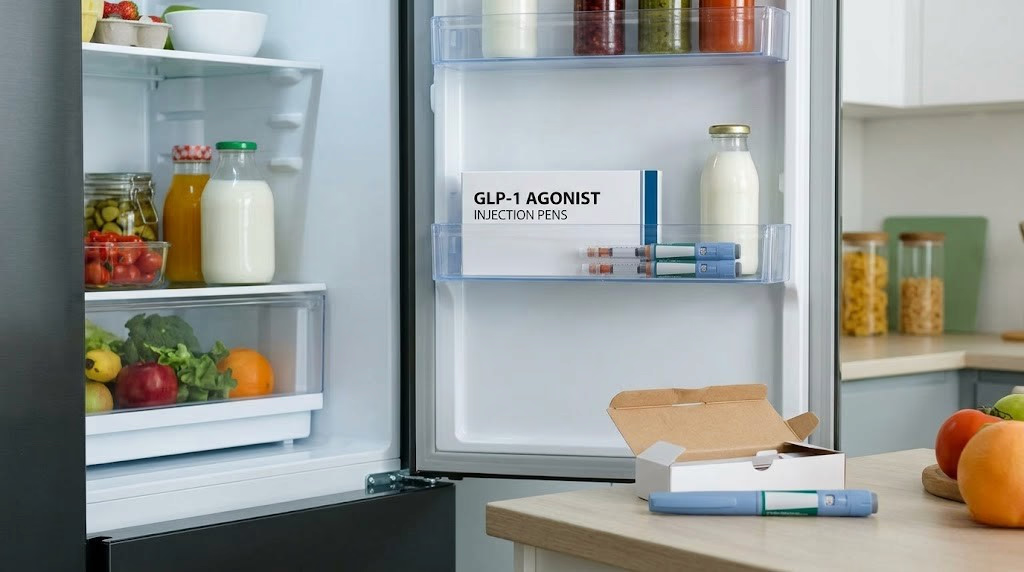
Store GLP-1 peptides — before reconstitution
When your GLP-1 peptides arrive, they are in lyophilised form — a freeze-dried powder cake inside a sealed glass vial. In this state, peptides are at their most stable, but they still require proper storage. Here is how to store GLP-1 peptides before you are ready to use them:
- Refrigerate immediately: Place vials in your refrigerator at 2–8°C as soon as they arrive. The middle shelf — away from the back wall where freezing can occur — is ideal.
- Keep them dry: Moisture is an enemy of lyophilised powder. Store vials in their original sealed packaging or a sealed container.
- Protect from light: UV and direct light accelerate degradation. Keep vials in their box or inside a dark container within the fridge.
- Do not freeze unless for long-term storage: Freezing at -20°C is acceptable for long-term storage of unreconstituted peptides and can extend shelf life to 12+ months. However, repeated freeze-thaw cycles damage the product.
Most peptide suppliers ship with cold packs, but transit temperatures may rise above ideal levels during delivery. Brief exposure to room temperature (up to 25°C) for 24–48 hours during transit is generally tolerable for lyophilised peptides and does not significantly affect potency. Refrigerate immediately upon receipt. If you suspect prolonged heat exposure during delivery (e.g. the package sat in direct sunlight), contact your supplier to store GLP-1 peptides discussion.
Store GLP-1 peptides — how to reconstitute correctly
Reconstitution is the process of adding sterile liquid to the lyophilised powder to create an injectable solution. How you do this matters enormously — aggressive handling during reconstitution is one of the most common ways people damage their peptides before even taking the first dose.
What you need
- Bacteriostatic water (BAC water): This is the correct reconstitution fluid for multi-dose vials. It contains 0.9% benzyl alcohol as a preservative that prevents bacterial growth, allowing the reconstituted solution to last 28–30 days.
- Sterile syringe and needle: Use a fresh, sealed syringe for drawing water and a separate one for injection.
- Alcohol swabs: To clean the vial stoppers before piercing.
Step-by-step reconstitution
- Wipe the top of both the peptide vial and the bacteriostatic water vial with an alcohol swab and let dry.
- Draw the required volume of bacteriostatic water into a sterile syringe. The volume depends on your desired concentration — your supplier’s instructions will specify the recommended amount.
- Insert the needle into the peptide vial at a slight angle, aiming the water at the inside glass wall — not directly onto the powder cake.
- Depress the plunger slowly. Let the water trickle down the glass wall and pool at the bottom of the vial. This gentle approach prevents mechanical damage to the peptide chains.
- Once all water is added, remove the syringe. Do not shake the vial.
- If powder remains undissolved, gently roll the vial between your palms for 30–60 seconds. You may also leave it in the refrigerator for 15–30 minutes — most peptides dissolve fully with time and gentle movement.
- The final solution should be clear and colourless. If it is cloudy, contains visible particles, or is discoloured, do not use it.
Never shake a peptide vial. Vigorous shaking creates foam and introduces mechanical stress that physically breaks the peptide chains through a process called denaturation. This is the single most common reconstitution mistake, and it permanently reduces potency. If you need to dissolve remaining powder, gentle rolling or patient waiting is the only correct approach.
Store GLP-1 peptides — after reconstitution
Once reconstituted, the rules for how to store GLP-1 peptides become even more important because the dissolved peptide is now in its most vulnerable state. The solution is sensitive to heat, light, agitation, and bacterial contamination — all of which degrade potency over time.
- Refrigerate immediately: Place the reconstituted vial back in the fridge at 2–8°C. Never leave it out on a counter, in a bag, or at room temperature.
- Never freeze: Freezing a reconstituted peptide solution causes ice crystals that physically shred the peptide chains. This damage is irreversible.
- Keep upright: Store the vial standing upright to minimise the solution’s contact with the rubber stopper, which can leach chemicals over time.
- Protect from light: Keep the vial in its box or wrap it in foil inside the fridge.
- Use clean technique every time: Swab the stopper with alcohol before every draw. Use a fresh needle for each injection. Contamination introduced through a dirty needle can render the entire vial unsafe.
Store GLP-1 peptides — shelf life at every stage
| Stage | Storage condition | Shelf life |
|---|---|---|
| Lyophilised (sealed, fridge) | 2–8°C refrigerator | 3–6 months (check supplier date) |
| Lyophilised (sealed, freezer) | -20°C freezer | 12+ months |
| Reconstituted with BAC water | 2–8°C refrigerator | 28–30 days |
| Reconstituted with sterile water | 2–8°C refrigerator | 48–72 hours only |
| Reconstituted, left at room temp | Above 8°C | Degrading — use immediately or discard |
Always use bacteriostatic water to reconstitute multi-dose vials. The benzyl alcohol preservative prevents bacterial growth over the 28–30 day usage period. Sterile water contains no preservative and should only be used if the entire vial will be consumed in a single dose within 48–72 hours. Using sterile water for a multi-dose vial is a contamination risk that can cause infection. This is one of the most important details when learning how to store GLP-1 peptides safely.
Store GLP-1 peptides — 7 mistakes that destroy potency
1. Shaking the vial
Vigorous shaking denatures peptide chains through mechanical stress and foam creation. Gentle rolling between palms is the only correct method to dissolve remaining powder.
2. Leaving reconstituted peptides at room temperature
Every hour at room temperature accelerates degradation. After drawing your dose, the vial goes straight back in the fridge — no exceptions. Learning to store GLP-1 peptides means making this automatic.
3. Freezing reconstituted solutions
Ice crystals physically destroy dissolved peptide chains. Only unreconstituted lyophilised powder can be frozen. Once mixed, refrigeration only — never the freezer.
4. Spraying water directly onto the powder cake
Directing the water stream straight onto the lyophilised cake can break peptide bonds through impact force. Always aim the water at the inside wall of the vial and let it trickle down gently.
5. Using sterile water instead of bacteriostatic water
Sterile water has no preservative. In a multi-dose vial that is accessed multiple times over several weeks, bacteria introduced through each needle entry will multiply freely. BAC water prevents this. If you only have sterile water, use the entire vial within 48 hours.
6. Storing near heat sources or in direct light
Windowsills, radiators, warm bathrooms, and car dashboards are all common storage locations that destroy peptide potency. The only correct location to store GLP-1 peptides is inside a refrigerator, away from the back wall and light.
7. Reusing needles
Every needle entry into a vial is a potential contamination event. Using a fresh, sterile needle each time is essential for maintaining the sterility of your reconstituted solution over its 28–30 day shelf life.
Store GLP-1 peptides — signs your peptide has degraded
Peptide degradation is not always visible, but when it is, these are the warning signs:
- Cloudiness or haziness: A properly reconstituted peptide should be clear and colourless. Cloudiness indicates aggregation or contamination.
- Visible particles or floaters: Small particles in the solution suggest degradation or contamination. Do not inject.
- Discolouration: Any yellow, brown, or otherwise coloured tint indicates chemical degradation. Discard the vial.
- Unusual smell: A strong or unusual odour when you open or draw from the vial may indicate bacterial contamination.
- Reduced efficacy: If your appetite suppression, weight loss, or other expected effects have diminished without a dose change, degraded peptide is a possible cause — especially if your storage practices have not been ideal.
If in doubt, throw it out. A single vial of peptide is far less expensive than the consequences of injecting a contaminated or degraded product. When you store GLP-1 peptides correctly from the start, you should never encounter these issues.
Best practiceCommon questions — store GLP-1 peptides
Get your GLP-1 peptides from Mymetabolism.
HPLC-verified at 99% purity, COA on every batch, cold-chain shipped with temperature packs, free UK delivery. Stored correctly from our lab to your fridge.
Browse products →