
What is Retatrutide? 7 proven facts about the best weight loss injection.
What is Retatrutide? It is the question driving one of the fastest-growing searches in UK weight management right now — and the answer is remarkable. Retatrutide (LY3437943) is a first-in-class triple hormone receptor agonist developed by Eli Lilly. It activates three separate hormonal pathways simultaneously — GIP, GLP-1, and glucagon — making it the most mechanistically advanced weight loss medication ever to reach Phase 3 clinical trials. The results are extraordinary.
In May 2026, Eli Lilly published the TRIUMPH-1 Phase 3 trial results — the most anticipated data release in obesity medicine in years. The headline figure: participants on the 12mg dose lost an average of 28.3% of their body weight over 80 weeks. Forty-five percent of patients lost 30% or more — a threshold previously only associated with bariatric surgery. This guide answers what is Retatrutide in full — covering mechanism, clinical data, dosage, side effects, and how to access it in the UK. All data is drawn from the official Eli Lilly TRIUMPH-1 trial announcement and the NHS healthy weight guidance.
What is Retatrutide — the full explanation
So what is Retatrutide exactly? It is a synthetic peptide — a small protein chain — designed to mimic and simultaneously activate three natural gut hormones: GIP (glucose-dependent insulinotropic polypeptide), GLP-1 (glucagon-like peptide-1), and glucagon. Each of these hormones plays a distinct role in appetite regulation, blood sugar management, and energy metabolism. By activating all three at once through a single once-weekly injection, Retatrutide creates a combined metabolic effect that no single or dual receptor medication can replicate.
Retatrutide was developed by Eli Lilly — the same company behind Mounjaro (Tirzepatide). It is part of their next-generation obesity pipeline and has been studied under the TRIUMPH Phase 3 programme since late 2023. What is Retatrutide classified as? It belongs to the incretins class of medications — hormone-based therapies that work with the body’s natural regulatory systems rather than stimulating the nervous system like older weight loss drugs.
How does Retatrutide work?
Understanding what is Retatrutide requires understanding its three-pathway mechanism. Each receptor it activates contributes differently to the overall weight loss effect:
- GLP-1 receptor activation — reduces appetite by signalling fullness to the brain, slows gastric emptying so food stays in the stomach longer, and improves insulin sensitivity. This is the same pathway activated by Ozempic and Wegovy
- GIP receptor activation — enhances fat metabolism, amplifies the appetite-suppressing effects of GLP-1, and improves the body’s ability to process glucose. This is the same second pathway activated by Mounjaro
- Glucagon receptor activation — this is what sets Retatrutide apart from everything else. Glucagon receptor activation increases energy expenditure by stimulating the liver to burn fat directly, raising the body’s metabolic rate. No other approved or investigational weight loss medication activates this pathway
The synergistic effect of all three pathways working simultaneously is greater than the sum of its parts. In clinical trials, Retatrutide produced weight loss results that exceeded both Ozempic and Mounjaro at every comparable data point — not just marginally, but significantly. This is the mechanistic answer to what is Retatrutide and why it represents a genuine step change in obesity medicine.
The glucagon receptor component of Retatrutide increases energy expenditure — meaning your body burns more calories even at rest. This is a fundamentally different mechanism from appetite suppression alone, and is the primary reason Retatrutide weight loss results exceed those of dual-receptor medications like Mounjaro.
Retatrutide weight loss results — TRIUMPH-1 Phase 3 data
The TRIUMPH-1 Phase 3 trial is the most significant obesity drug trial published in 2026. Here is what the data shows for Retatrutide weight loss results at 80 weeks across the three active dose arms:
| Dose | Average weight loss | Patients losing ≥20% | Patients losing ≥30% |
|---|---|---|---|
| 4mg (maintenance) | 17.6% | ~28% | ~8% |
| 9mg (maintenance) | 23.7% | ~48% | ~20% |
| 12mg (maintenance) | 25.0% (28.3% at max tolerated dose) | ~58% | 45.3% |
| Placebo | 3.9% | <2% | <1% |
To contextualise these Retatrutide weight loss results: the TRIUMPH-4 trial published in December 2025 showed participants with obesity and knee osteoarthritis on the 12mg dose lost an average of 28.7% of body weight at 68 weeks — equivalent to an average of 71.2 lbs (32.3 kg). For a person starting at 120kg, a 28% reduction means losing over 33kg. These are the most significant pharmacological weight loss results ever recorded.
Retatrutide vs Mounjaro vs Ozempic — how they compare
One of the most common follow-up questions after understanding what is Retatrutide is how it stacks up against existing medications. Here is a direct comparison:
| Medication | Mechanism | Average weight loss | Patients losing ≥30% |
|---|---|---|---|
| Ozempic/Wegovy (Semaglutide) | GLP-1 only | ~15% | <5% |
| Mounjaro (Tirzepatide) | GIP + GLP-1 | ~22% | ~10% |
| Retatrutide | GIP + GLP-1 + Glucagon | 25–28.3% | 45.3% |
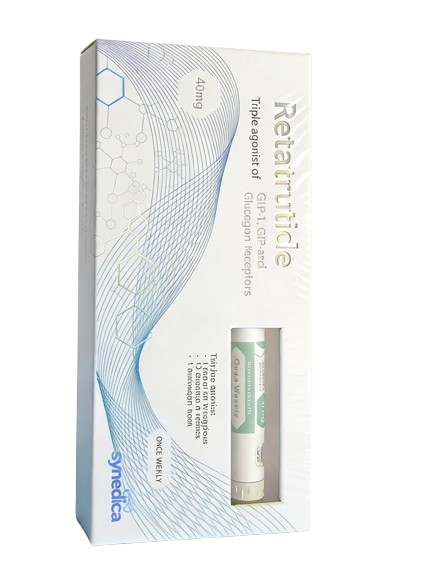
The pattern is clear — each additional hormonal pathway produces meaningfully better results. Retatrutide’s glucagon component is the critical differentiator, and the clinical data leaves no ambiguity about the magnitude of that difference. For patients who have plateaued on Mounjaro or want the most powerful option available from the start, Retatrutide weight loss results make a compelling case. Browse our full product range including both VLS Retatrutide and Synedica Retatrutide.
Retatrutide dosage schedule
Based on the TRIUMPH Phase 3 trial protocols, Retatrutide follows a gradual escalation schedule from 2mg to the target maintenance dose. The escalation is slower than Mounjaro’s schedule — reflecting the greater potency of the triple mechanism and the need for careful dose titration.
| Weeks | Dose | Phase |
|---|---|---|
| Weeks 1–4 | 2mg once weekly | Starting dose |
| Weeks 5–8 | 4mg once weekly | First escalation |
| Weeks 9–12 | 8mg once weekly | Second escalation |
| Week 13 onward | 9mg or 12mg once weekly | Maintenance — peak results phase |
The 12mg maintenance dose produced the highest Retatrutide weight loss results in all trial arms. Never increase faster than this schedule — the gradual escalation exists to minimise side effects and allow safe adaptation. Contact our 24/7 support team with any dosing questions.
Retatrutide side effects — what to expect
Retatrutide side effects are consistent with the GLP-1 class of medications — primarily gastrointestinal and most pronounced during dose escalation. The most commonly reported effects in TRIUMPH-1 were nausea, diarrhoea, vomiting, and reduced appetite. Most resolve within 3 to 7 days of each dose increase as the body adapts. The rate of discontinuation due to side effects in the trial was approximately 8% — lower than some earlier GLP-1 medications despite the greater potency.
- Nausea — most common, typically mild, peaks in the first 48 hours after each dose increase
- Diarrhoea — common during escalation phases, typically resolves within a week at each new dose
- Vomiting — less common, usually accompanies severe nausea in the early escalation period
- Fatigue — particularly common after each dose increase, usually resolves within 3 to 5 days
- Reduced appetite — the intended primary effect, which persists throughout treatment
- Injection site reactions — mild redness or discomfort, minimised by rotating injection sites weekly
Never increase your Retatrutide dose faster than the prescribed schedule. The most common cause of severe side effects is premature dose escalation. If you experience persistent or severe symptoms, contact our 24/7 support team before making any changes to your protocol.
Where to buy Retatrutide in the UK
Retatrutide is not yet approved for prescription in the UK — MHRA approval is estimated 2027 to 2028 based on current regulatory timelines. However, it is available for research use from verified suppliers like Mymetabolism. We supply two verified Retatrutide formulations — VLS Retatrutide and Synedica Retatrutide — both HPLC-verified at 99% purity with a Certificate of Analysis on every batch.
When you buy Retatrutide from Mymetabolism, you receive free discreet UK shipping, 24/7 support throughout your treatment, and full transparency on purity through our published Certificate of Analysis. Read our verified customer reviews to see what our customers say, and visit our shop page to browse both Retatrutide options alongside our full GLP-1 range.
“Retatrutide represents the most significant advance in obesity pharmacotherapy since GLP-1 receptor agonists were first approved. The TRIUMPH-1 data puts this medication in a different category entirely from anything currently available.”
— Mymetabolism clinical summary, June 2026Common questions about what is Retatrutide
Buy Retatrutide from Mymetabolism today
HPLC-verified at 99% purity, COA on every batch, free UK shipping. VLS Retatrutide and Synedica Retatrutide — the most powerful weight loss medication available.
Shop Retatrutide now →