
Sermorelin vs ipamorelin — 7 critical facts, honest guide.
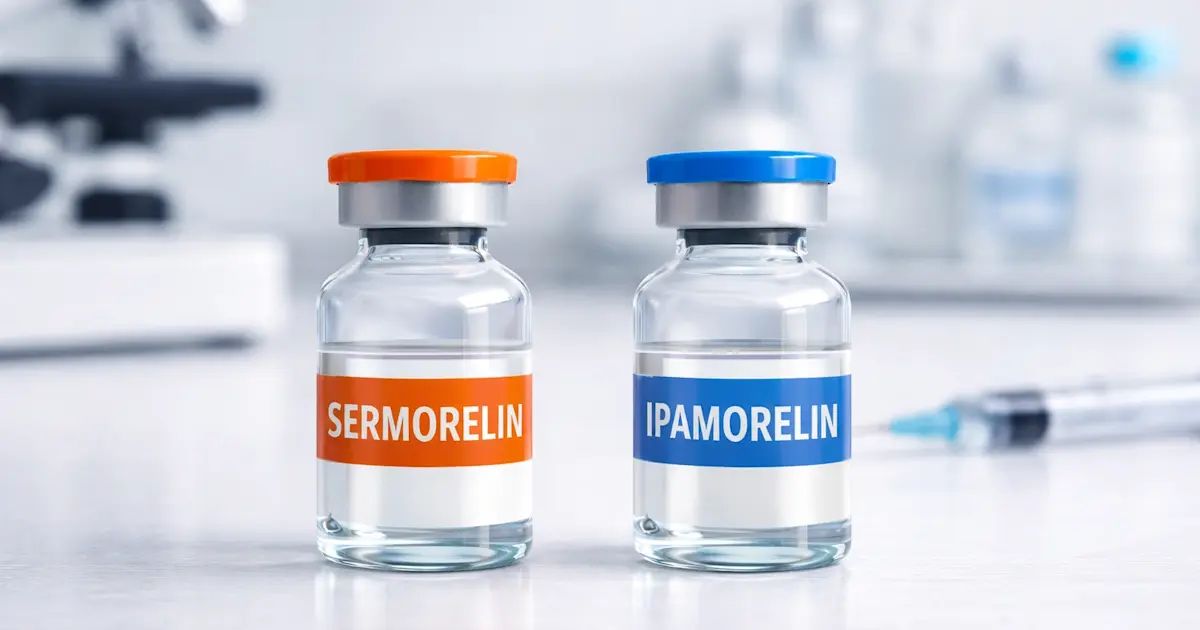
Sermorelin vs ipamorelin is one of the most common comparisons in the growth hormone peptide world. Both are discussed for recovery, body composition and healthy ageing, and both are often sold side by side.
This honest guide compares sermorelin vs ipamorelin across 7 critical facts: how each works, what the research shows, side effects, UK legal status and anti-doping rules. It doesn’t give dosing advice, because neither has an established safe dose for these uses.
Neither sermorelin nor ipamorelin is a licensed medicine in the UK. This article is for information only and isn’t medical advice.
Mymetabolism supplies research compounds with a batch-specific certificate of analysis and free UK shipping. Explore the Mymetabolism shop →
The basics
To understand sermorelin vs ipamorelin, start with growth hormone itself. It’s made by the pituitary gland at the base of the brain. It’s released in pulses, mostly during deep sleep, and plays a role in growth, metabolism, muscle and bone.
Levels naturally fall with age. That decline is why compounds that encourage the body to release more of its own growth hormone attract so much interest.
Sermorelin and ipamorelin are two such compounds, which is why the sermorelin vs ipamorelin comparison comes up so often. Rather than supplying growth hormone directly, both are designed to prompt the pituitary gland to release it.
A short history
Sermorelin emerged from research in the 1980s, after scientists identified growth hormone-releasing hormone. A shortened version proved active, and that became sermorelin.
Ipamorelin came later, in the 1990s, from work on synthetic growth hormone secretagogues. Researchers wanted a compound that released growth hormone without disturbing other hormones.
That history shapes the sermorelin vs ipamorelin story today. One was a medicine that left the market; the other never became one.
Sermorelin vs ipamorelin: 7 critical facts
These seven facts capture the most important differences and similarities in the sermorelin vs ipamorelin debate.
1. They work through different receptors
Sermorelin copies the first 29 amino acids of growth hormone-releasing hormone (GHRH) and acts on the GHRH receptor. Ipamorelin mimics ghrelin and acts on the growth hormone secretagogue receptor.
2. Sermorelin was once an approved medicine
Sermorelin was approved in the United States for diagnosing and treating growth hormone deficiency in children. The branded product was withdrawn from the US market in 2008, a decision reported as commercial rather than safety-related.
3. Ipamorelin never reached approval
Ipamorelin was developed in the 1990s and tested in clinical trials, including for gut recovery after surgery. It was never approved as a medicine anywhere.
4. Ipamorelin is described as more selective
Early studies suggested ipamorelin raises growth hormone with less effect on other hormones such as cortisol and prolactin than older compounds in its class. That selectivity is a big part of its reputation.
5. Neither has strong evidence for popular claims
Claims about anti-ageing, fat loss, muscle gain and better sleep aren’t backed by large, well-controlled human trials for either compound.
6. Neither is licensed in the UK
Both are supplied as research materials in the UK. Our research peptides UK legal guide explains what that means.
7. Both are banned in sport
Growth hormone-releasing factors, including GHRH analogues and growth hormone secretagogues, are prohibited at all times under anti-doping rules.
Sermorelin vs ipamorelin is a comparison of mechanisms, not of proven results. Neither has the evidence its reputation suggests.
Mymetabolism TeamHow each one works
The sermorelin vs ipamorelin difference starts with how your body controls growth hormone, using two main signals. GHRH tells the pituitary to release growth hormone, and ghrelin, best known as a hunger hormone, also stimulates release through a separate receptor.
Sermorelin acts like GHRH. It’s a shortened version of the natural hormone that keeps the active part, so it encourages the pituitary to release growth hormone in its normal pulses.
Ipamorelin acts like ghrelin at the growth hormone secretagogue receptor. It’s a small synthetic peptide of five amino acids, designed to trigger growth hormone release while affecting other hormones as little as possible.
Because sermorelin vs ipamorelin is really GHRH vs ghrelin, some people combine a GHRH analogue with a secretagogue. That’s the idea behind pairings such as CJC-1295 and ipamorelin, covered in our CJC-1295 vs ipamorelin guide.
| Feature | Sermorelin | Ipamorelin |
|---|---|---|
| Type | GHRH analogue | Growth hormone secretagogue |
| Receptor | GHRH receptor | Ghrelin (GHS) receptor |
| Size | 29 amino acids | 5 amino acids |
| Approval history | Approved in the US, withdrawn in 2008 | Never approved |
| UK licence | No | No |
| Banned in sport | Yes | Yes |
At a glance
If you only remember a few points about sermorelin vs ipamorelin, make them these:
- Mechanism: sermorelin mimics GHRH; ipamorelin mimics ghrelin
- History: sermorelin was once approved in the US; ipamorelin never was
- Selectivity: ipamorelin is described as affecting fewer other hormones
- Evidence: neither has strong human data for anti-ageing or fat loss
- Status: neither is licensed in the UK, and both are banned in sport
In short, sermorelin vs ipamorelin is mostly a difference of route, not of proven benefit.
What the research shows
On evidence, sermorelin vs ipamorelin tilts slightly towards sermorelin, which has the longer clinical history. It was studied and used in children with growth hormone deficiency, and smaller studies looked at its effects in older adults.
On the ipamorelin side of sermorelin vs ipamorelin, human research is more limited. Early studies measured its effect on growth hormone release, and later trials looked at recovery of gut function after surgery, without leading to approval.
For the claims that drive online interest, such as slowing ageing, burning fat or building muscle, neither compound has strong evidence from large, well-controlled human trials. Raising growth hormone levels doesn’t automatically mean better health or body composition.
When reading claims about sermorelin vs ipamorelin, always separate laboratory and hormone-level findings from real-world outcomes. They’re very different things.
The IGF-1 link
Growth hormone works partly by raising IGF-1, a hormone made mainly in the liver. IGF-1 drives many of growth hormone’s effects on muscle, bone and tissue repair.
Both sides of sermorelin vs ipamorelin aim to raise IGF-1 indirectly, through growth hormone. But IGF-1 also influences cell growth, which is why long-term raised levels are watched carefully in medicine.
In sermorelin vs ipamorelin discussions online, IGF-1 is often quoted as proof that a peptide “works”. A higher number on a blood test isn’t the same as better health.
The popular claims
Online, both sides of sermorelin vs ipamorelin are promoted for better sleep, faster recovery, more lean muscle, less body fat, healthier skin and slower ageing. These claims usually lean on what growth hormone does in people with a genuine deficiency.
But treating a diagnosed deficiency is very different from boosting levels in healthy adults. In people with normal growth hormone levels, the benefits of pushing levels higher are unclear, and the risks are less studied.
That gap is the honest heart of the sermorelin vs ipamorelin question. Both can raise growth hormone; neither has proven it makes healthy people healthier.
Older adults and ageing
Much of the interest in sermorelin vs ipamorelin comes from older adults hoping to offset the natural fall in growth hormone. It’s an understandable goal, but the evidence is thin.
Small studies of sermorelin in older people measured hormone levels and some markers of body composition, with modest and inconsistent results. Ipamorelin hasn’t been studied in this way to any meaningful degree.
Raising growth hormone in older adults also carries possible downsides, including effects on blood sugar and fluid balance. For healthy ageing, exercise, sleep and nutrition have much stronger evidence than either side of the sermorelin vs ipamorelin debate.
Can they be combined?
Because sermorelin and ipamorelin act on different receptors, online sources often suggest using them together for a bigger effect. The theory is that a GHRH signal plus a ghrelin-type signal releases more growth hormone than either alone.
That idea has some basis in hormone biology, but combining unlicensed compounds also combines their unknowns. There’s no strong clinical evidence that combining them is safe or beneficial in healthy people.
So the sermorelin vs ipamorelin choice isn’t solved by using both. It simply doubles the uncertainty.
Side effects and safety
In the sermorelin vs ipamorelin comparison, reported side effects are broadly similar. Growth hormone-releasing compounds can cause injection-site reactions, flushing, headache, dizziness and water retention. Raised growth hormone can also affect blood sugar and insulin sensitivity.
Long-term safety in healthy adults hasn’t been established on either side of sermorelin vs ipamorelin. Because growth hormone and IGF-1 influence cell growth, researchers urge caution for anyone with a history of cancer.
In sermorelin vs ipamorelin safety terms, ipamorelin’s selectivity may mean fewer effects on cortisol and prolactin, but that doesn’t make it risk-free. Research-market products also vary in purity, which adds another layer of uncertainty.
Sleep and growth hormone
Growth hormone is released mostly during deep sleep, which is why sermorelin vs ipamorelin often comes up in sleep discussions. The link works the other way too: poor sleep reduces natural growth hormone release.
That’s good news for anyone weighing sermorelin vs ipamorelin for sleep, because improving sleep is free and proven. Our guide to sleep on GLP-1 covers practical habits that support deeper rest.
Muscle, fat and weight loss
Neither side of sermorelin vs ipamorelin is a proven weight-loss treatment. If your goal is losing weight, licensed medicines prescribed by a clinician have far stronger evidence, as our Wegovy vs Mounjaro comparison explains.
If you’re losing weight and want to protect muscle, the evidence points to protein, strength training and steady progress. Our guides to GLP-1 and muscle loss and protein on GLP-1 medications cover proven approaches.
For a wider view of peptides discussed for body composition, see our best peptides for fat loss guide.
Cost versus value
Research peptides can be expensive, especially when bought regularly. When weighing sermorelin vs ipamorelin, compare the cost against the strength of the evidence.
The same money spent on strength training, better sleep or a dietitian has far stronger evidence for body composition and healthy ageing. It also carries none of the legal, safety or anti-doping risk.
For most people, the honest verdict on sermorelin vs ipamorelin is that neither is the best use of their budget.
UK legal status
Legally, sermorelin vs ipamorelin is a draw. Neither is a controlled drug in the UK, so possessing them isn’t a drugs offence. But neither has a UK medicine licence, so medicines law governs how they can be sold.
Supplied genuinely as research materials, they sit alongside other research peptides. Marketed for human use, with health claims or dosing instructions, they can be treated by the MHRA as unlicensed medicines.
Our research peptides UK legal guide explains enforcement, imports and what sellers must avoid.
Anti-doping rules
The WADA Prohibited List bans growth hormone-releasing factors at all times, including GHRH analogues like sermorelin and secretagogues like ipamorelin.
For athletes, sermorelin vs ipamorelin makes no difference: UK Anti-Doping applies these rules under strict liability, so tested athletes are responsible for anything in their sample. Using either peptide risks a ban, whatever the reason.
Quality and purity
In the sermorelin vs ipamorelin market, quality varies. If either peptide is bought for genuine laboratory research, look for a batch-specific certificate of analysis showing purity, testing method and the laboratory. The batch number should match the product.
Peptides degrade with heat and light, so storage matters in any sermorelin vs ipamorelin research. Our guide to storing peptides covers the basics.
Common myths
Myth one: “Sermorelin is safe because it was approved.” It was approved for children with a diagnosed deficiency, under medical supervision, not for healthy adults using research-market products.
Myth two: “Ipamorelin has no side effects.” It may be more selective, but it isn’t free of risk, and long-term data in healthy people don’t exist.
Myth three: “More growth hormone always means better health.” In people with normal levels, pushing growth hormone higher hasn’t been shown to improve health and may carry risks.
Myth four: “One of them is clearly better.” The sermorelin vs ipamorelin question has no proven winner, because neither has strong evidence for the outcomes people want.
Questions to ask first
Before looking further into sermorelin vs ipamorelin, ask yourself these questions:
- Has a doctor confirmed any problem with my growth hormone levels?
- What exactly am I hoping to achieve, and is there a proven way to get there?
- Do I have any condition, such as diabetes or a history of cancer, that raises the risk?
- Am I subject to anti-doping testing in my sport or job?
- Would I know the true contents and purity of the product?
Honest answers usually point towards a conversation with a doctor rather than a research peptide.
Who should be especially cautious
Anyone who is pregnant, breastfeeding or under 18 should avoid unlicensed growth hormone-releasing compounds. So should people with active or past cancer, diabetes or serious heart conditions.
Anyone taking prescription medicines should speak to their doctor, because interactions haven’t been studied. Competitive athletes face the added risk of a ban.
Talking to your doctor
If you’re worried about low energy, poor recovery or changes in body composition, a GP can look for causes such as thyroid problems, low iron, poor sleep or hormone issues. Genuine growth hormone deficiency is diagnosed with specific tests and treated by specialists with licensed medicines.
If you’ve already tried either side of sermorelin vs ipamorelin, or another research peptide, tell your doctor. It helps them interpret symptoms and test results accurately.
How they compare with other peptides
Sermorelin vs ipamorelin sits within the growth hormone group of research peptides. Others are discussed for very different reasons: BPC-157 and TB-500 for recovery, GHK-Cu for skin and Epithalon for ageing.
See our guides to TB-500, BPC-157 and GHK-Cu for more.
The bottom line
In the sermorelin vs ipamorelin comparison, the real difference is how they work. Sermorelin mimics GHRH, ipamorelin mimics ghrelin, and both aim to raise the body’s own growth hormone.
Sermorelin has a longer medical history, while ipamorelin is known for selectivity. But neither is licensed in the UK, neither has strong evidence for popular claims and both are banned in sport.
Whatever you conclude about sermorelin vs ipamorelin, if you’re concerned about growth hormone, energy or ageing, start with a doctor. Proven habits and licensed treatments remain the safest route.
Common questions — sermorelin vs ipamorelin
Explore the Mymetabolism shop.
Batch-specific certificate of analysis, free UK shipping and 24/7 support.
Explore the Shop →